
Trainers: Michael Carroll
NLP Trainers Training
and Certification
and Certification
Welcome to the NLP Academy, Global Trainers Training hosted in conjunction with The International Trainers and Coaching Academy (ITCA). This is the only trainers training in the world, led by International Master Trainer, Michael Carroll, which is endorsed by NLP co-creator Dr John Grinder and Carmen Bostic St Clair and offers graduates the opportunity to run officially recognised NLP certification courses as members of ITCA with certificates signed by John Grinder, Carmen Bostic St Clair and Michael Carroll.
The NLP Academy/ITCA Trainers Training is the leading trainers training in the world and is designed to bring high-quality NLP courses to communities around the globe, led by ITCA-approved trainers with a focus on quality, standards and professionalism.
NLP Academy Founder and course director, Michael Carroll, is the lead trainer throughout the course.
The course follows the same structure as previous NLP Academy Trainers trainings, led annually by John Grinder, Carmen Bostic St Clair and Michael Carroll from 2006 to 2021. Attendees will participate in three modules, each of which has a very specific set of skills for delegates to attain and demonstrate competency with.
Module One
Love Public Speaking, Advanced NLP Presentation Skills.
25-29 October 2027 / 1.00 pm to 8.00 pm
Over these five days, Michael Carroll and his guests will deliver a direct and practical programme focused on how to apply NLP tools to deliver layered learning experiences in groups through engaging teaching presentations.
- Available online or in person
Module Two
The Art and Science of Teaching NLP
31 October – 5 November 2027 / 1.00 pm to 8.00 pm
Over these six days, principal trainer, Michael Carroll, will share his 30 years of experience in teaching NLP certifications, and 20 years of experience working alongside John Grinder and Carmen Bostic St Clair to provide delegates with structure, strategy and skills to deliver their own ITCA Approved NLP Courses.
- Available for in-person attendees only
Module Three
NLP Trainer Evaluation
7 – 9 November 2027 / 10.00 am to 6.00 pm
Over these four days, candidates will be evaluated on their NLP presentation competencies, ability to conduct NLP demonstrations in front of a live audience, and NLP knowledge.
- Available for in-person attendees only

Training Options
Module One can be taken online, while Modules Two and Three must be attended in person. Successful completion of the NLP Trainer Evaluation will earn the candidate the title of Certified NLP Trainer. You will be approved to offer NLP Practitioner Courses in “Classic NLP” that are in keeping with ITCA Standards.
Module One: 25-29 October / 1.00 pm to 8.00 pm
Love Public Speaking, Advanced NLP Presentation Skills
The art of any successful teaching and learning experience is the ability for the instructor to create naturalistic contexts for creating conscious and unconscious engagement. This module will give delegates all the tools and strategies to deliver charismatic and engaging presentations following a specific structure designed by NLP co-creator Dr John Grinder for learning.
An excellent public speaker and presenter owns the space and is fearless on stage. They know how to maximise the use of their tonality to enhance their message, and they use their body language to engage the audience. They are also gifted storytellers, and they structure their material in such a way that it is naturally absorbed by the audience, allowing for maximum retention. You will learn all of this and more during the six-day module on Advanced Presentation and Public Speaking Skills.What you will learn in Module One
- The optimal trainer state for engaging any audience with confidence.
- How to have absolute certainty on stage and break any fears connected with public speaking.
- Developing a high level of self-awareness as a presenter so you are tuned into all feedback.
- Triple description as a mechanism for self-feedback for continual self-improvement as a presenter.
- How to develop rapid-group rapport with large and small audiences so that you, as a presenter, have the total attention of the group.
- Identifying informal group leaders and utilising the natural influence they have with other members of the group.
- Pacing and leading the conscious and unconscious mind of audience members, building individual and group responsiveness.
- How to answer difficult questions with rapport, enhancing your credibility.
- How to quickly read an audience so you can maximise the effect of your message.
- Understanding how groups, sub-groups and individuals relate to each other to accentuate group rapport and create a harmonious learning environment.
- How to build dynamic and engaging sessions to maximise the interest in your presentation.
- How to create sessions that harness the conscious and unconscious mind of learners, creating a lasting ‘whole mind’ learning experience.
- How to frame presentations to set the scene for conscious expectations.
- How to deliver tailored sessions for unconscious learning and long-term behavioural change.
- How to design charismatic presentations using multiple descriptions and connecting with the audience at a sensory level, creating enhanced recollection.
- How to utilise different postures for different steps in the presentation sequence, making it easy for the learner to experience the distinct types of content in your presentation.
- The distinctive tonalities that are anchored to visual, auditory and kinaesthetic language to create heightened charisma in your style and a versatile learning experience in the group.
- Tonal anchors to connect the unconscious minds of group members to the desired states inherent in your presentation.
- The hidden structure of charisma and the ultimate verbal rapport tool
- How to orchestrate sessions designed for different learning styles, so all the audience members feel included.
- How to transform interruptions into effective teaching points, minimising the effect of the interruption and keeping your presentation on track.
- How to recognise and answer the question behind the question, satisfying the deeper learning requirements of the questioner.
- How to elegantly handle hecklers/troublemakers and get them on your side, giving you a greater and more natural authority with the overall group.
- Using misdirection as a means of distracting the conscious mind and taking the learners into unexpected and positive territories, going beyond expectations.
- Deductive-style training sessions when you want the attendees to walk away with explicit learnings, usually expressed linguistically.
- Inductive-style learning when you want the participant to experience the learnings experientially, usually expressed in behaviour.
- The Grinder 8-Step format for presenting and training, a format that mirrors the context where learning experiences naturally occur, making it easier for participants to assimilate the content.
- Formatting the unconscious mind for learning, creating a framework for long-term recall and integration.
- The use of metaphor to set up teaching points for what is to come.
- Isomorphic metaphor and precise metaphor construction, to create direct object/process mappings.
- Multi-embedded metaphor, embedding different states in a metaphor for layering learnings.
- Nested and open loops in metaphor; how to nest stories within stories to create audience intrigue and unconscious engagement.
- Spatial anchoring with metaphor to chain states, link stories, and build an internal map of the content that is to be delivered.
On the final day of Module One, you will deliver a 35-minute presentation using all the skills you have learned. This presentation is designed to prepare you for Module Two.Module Two: 31 October - 5 November / 1.00 pm to 8.00 pm
The Art and Science of Teaching NLP
Classic NLP, as developed by John Grinder and Richard Bandler, is a highly specialised set of models and patterns that were derived from the modelling projects conducted by the NLP co-creators in their unique partnership that built NLP. The co-creators did not conduct a theoretical study of the NLP exemplars; they modelled their behaviours in the live contexts in which the exemplars worked.
The essence of this module is for the trainer to learn how to demonstrate in their own behaviour and be able to express in language every tool and technique they are teaching, both formally in the teaching demonstration and informally throughout the different stages of the presentation.
Module Two focuses on the delivery of Neuro-Linguistic Programming, equipping participants to teach it at multiple levels and apply it effectively with diverse client groups. As an NLP Trainer, you are likely to offer a range of courses as part of your business, for example: Introductory courses, NLP Practitioner courses, business courses and specialist application courses. In this module, you will learn about training style and design, how to sequence material and structure content to maximise learning.
NLP Training is both an art and a science. The artistry comes in the flair and flexibility a trainer exhibits in their metaphors, creative sessions and their elegance in conducting demonstrations. The science is in the formatting of each session and the precision in presenting factual content to set up the exercises. This blend of science and artistry creates the context for the sophisticated transfer of content.
This module will give you the complete NLP Trainer package to enable you to deliver in-depth sessions covering the full range of learning styles present in the group, with the material being assimilated unconsciously and understood consciously.
What you will learn in Module Two
- The structural style developed by John Grinder, to teach NLP, when it was created – the Grinder 8-Step format for training
- The discovery style – working inductively for the students to build their own learning map
- The art of chunking and sequencing – making it easy for learners to learn
- Looping in training to connect the different content elements
- Structuring NLP Practitioner content for maximum integration and long-term application of the material
- The logical levels of training design
Verbal interactions to leverage the learning experience
- Enhanced metaphor interaction, nesting loops, embedding commands, interactive metaphor, anchoring teaching points.
- Explicit verbal package and old-style meta model for precise questioning.
- Physiological Meta Model (non-verbal Meta Model), anchoring language patterns to elicit specific verbal responses.
- Using the learner’s current story interactively to embed the training content.
- Intention frame, Outcome frame, As-If frame to establish a learning direction.
- Explicate hidden intentions through paraphrase, misparaphrase and misdirection.
- Stage anchoring and tonal anchoring for state elicitation.
- Using the space for anchoring states and teaching points.
- Chaining states to create a movement to an outcome in the audience.
- Sliding tonal anchors to enhance the quality of static or chained states.
- Anchoring states and responses through gesture.
The skill behind artful NLP Demonstrations
- Positioning the demo as the key element in the training session
- Demo subject selection: how to pick the best person for the pattern being taught, the types of people not to pick.
- Recognising the difference in compliance and suggestibility, and why not use overly compliant or suggestible subjects.
- Creating powerful post-demo contexts of discovery to elicit learnings from the audience.
- Splitting your attention to calibrate the audience and demo subject
- Conducting demos with multiple demonstration subjects so the class can observe the responses in different people.
Experiences
- Aligning the exercise with the teaching points inherent in the demonstration.
- How to design exercises to create natural circuits in the learner for the skill being taught, building unconscious competence.
- Chunking exercises for maximum effect.
- Feedback and clean up after the exercise.
- Utilising all aspects of feedback, especially feedback where the students were challenged.
The distinctions between "content" and "process"
- Content and process, a primary ethical distinction in NLP
- The importance of keeping with the original NLP practice of process-oriented models in NLP training.
- How to convert ‘content’ oriented patterns to ‘process’ patterns to stay with NLP practice.
- How to develop your own ‘process’ patterns and models.
Module Three: 7 - 9 November / 10.00 am to 6.00 pm
Evaluation
In this phase, you will demonstrate your competency to the evaluation team with various activities to ensure you are ready to be an NLP Trainer. The evaluation process is rigorous; you will use all the skills you learnt in Modules One and Two throughout the evaluation, as well as your NLP Practitioner and NLP Master Practitioner skills.

- You will design and deliver two 35-minute NLP presentations.
- You will conduct an NLP demonstration.
- You will be tasked to present under challenging circumstances.
- You will also complete a closed-book written test on Classic NLP patterning.
The NLP Trainers training and rigorous evaluation are designed to create the best NLP Trainers in the world!
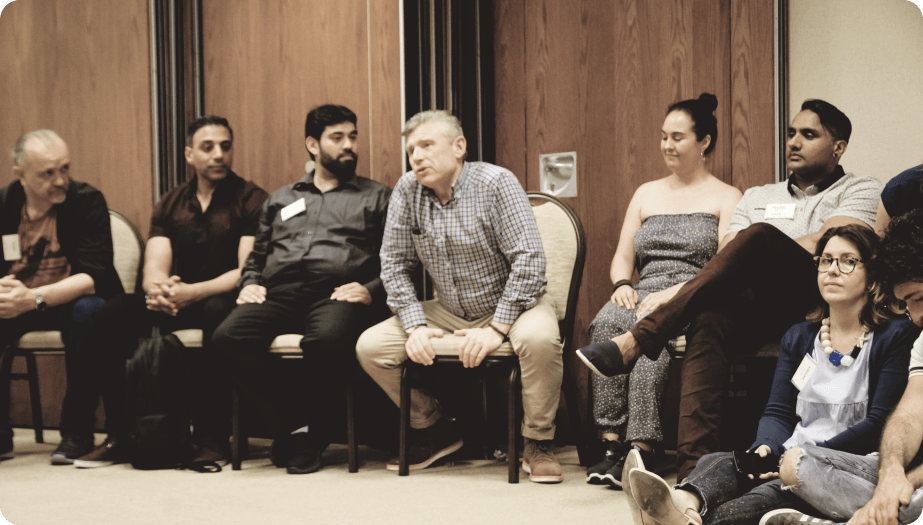
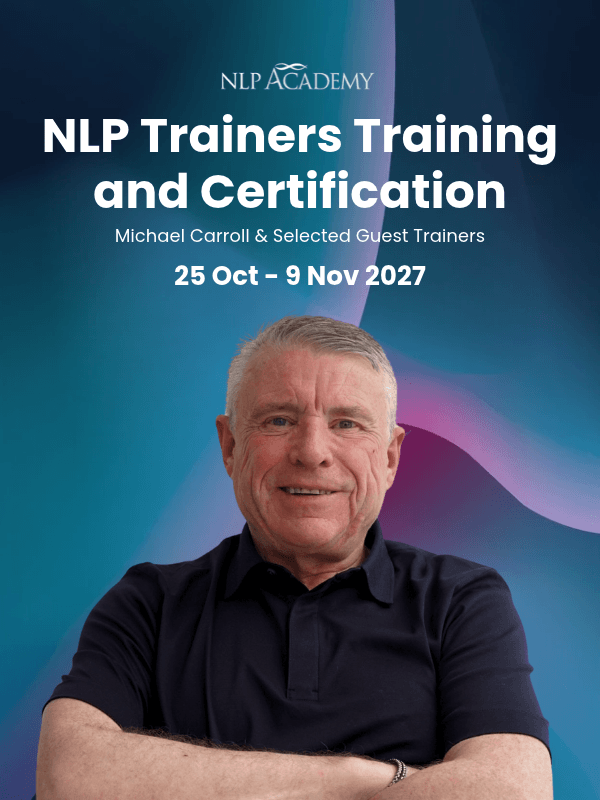
Learn with the global leaders in NLP excellence:
Boost your skills and open new opportunities by enrolling in our course today! This program is designed to give you practical knowledge, expert guidance, and hands-on experience that you can apply immediately.
Register below ⤵️
Michael Carroll Bio
Michael Carroll, is one of the most high-profile NLP Master Trainers in the world today, with a reputation of innovation and creativity for developing and delivering NLP programmes to the highest of standards with an emphasis on practical application.
Michael is the founder of The NLP Academy, established in 1996 which became and remains the global leader for NLP excellence. He is also the co – founder, with John Grinder and Carmen Bostic St Clair of The International Trainers and Coaching Academy, an official NLP certifying body and membership organisation for NLP Trainers and Coaches.
Michael is also the founder and lead trainer of the London hypnosis Academy (LHA). London Hypnosis Academy is a dedicated hypnosis training business offering Hypnosis Practitioner Certifications and specialty hypnosis courses on health and healing, working with addictions and hypnosis for trauma relief and PTSD.
Michaels application of NLP patterning go way the only ordinary. For example, he led a volunteer team of NLP Practitioners and Coaches in the Philippines, using NLP trauma relief protocols to work with the survivors of Typhoon Haiyan, which totally devasted the town of Tacloban and surrounding areas, taking the lives of 6000 people. This work led to similar projects, co-ordinated remotely applying NLP patterns for trauma relief in regions hit by natural disasters.
Michael’s reputation in the field of NLP is highly acknowledged by his peers and he has formed professional relationships and friendships with many of the people who were instrumental in the original NLP modelling work and leaders in NLP
Michael is known for his long-standing relationship with NLP co-creator Dr John Grinder and New Code NLP co-creator Carmen Bostic, St Clair. This relationship began in 1998, when Michael was a student in John and Carmen’s courses which transformed into a professional relationship in 2001, when Michael coordinated the online Whispering in the Wind project, an online discussion platform focussing on John and Carmen’s work.
Michael became John and Carmen’s promotor in 2002 and then a co-trainer on NLP certification programmes in 2005, and soon he was co-developing new patterns with John and Carmen leading to Michael being awarded co -developer of New Code NLP status.
Michael also has a very long standing relationship with leading Ericksonian Hypnosis pioneer, Stephen Gilligan, who was a part of original NLP modelling project of Milton Erickson. Stephen was key in acting as the prototype of Erickson for Grinder and Bandler to create the Milton Model. Stephen and Michael have been working together for over 20 years on specialist courses at The NLP Academy and London Hypnosis Academy.
Michael, together with Richard Bandler’s business partner, John La Valle was the co-organiser of the official 50th anniversary celebration of NLP, which saw John Grinder and Richard Bandler appear at the same Zoom event, NLP 50. In this unique event, Grinder and Bandler shared their own unique perspectives on the joint endeavour, the creation of Neuro Linguistic Programming and it was the first time, Michael
Michael has a deep commitment to the people who attend NLP Academy courses, and uses his enormous skills as trainer to ensure he creates a safe yet challenging learning space for people to enjoy experiential learning to have solid takeaways to apply NLP across all areas of their life.
Michael enjoys being on the move and splits his time between his homes in The Algarve, Portugal, Murcia Spain and Surrey, England. Michael has four adult children and has recently became a grandfather of two gorgeous granddaughters that he adores and is certainly enjoying his new role as a grandad.The Application Process for NLP Academy Trainers Training
1. Please complete your details on the form below.
2. You will receive an email with a link to the Trainers Training Application Form for you to complete.
3. The Trainers Training team will review your application form to confirm your eligibility for Trainers Training.
4. You will be invited to attend a 30-minute Zoom call with one of the Trainers, for us to get to know each other and ensure our outcomes are aligned for your participation in Trainers Training.
5. We will confirm your place and the business elements such as completing the investment for the course, course logistics etc. When the registration process is completed you will receive an official confirmation, an invoice for your payment, and all the details on how to best prepare for Trainers Training.